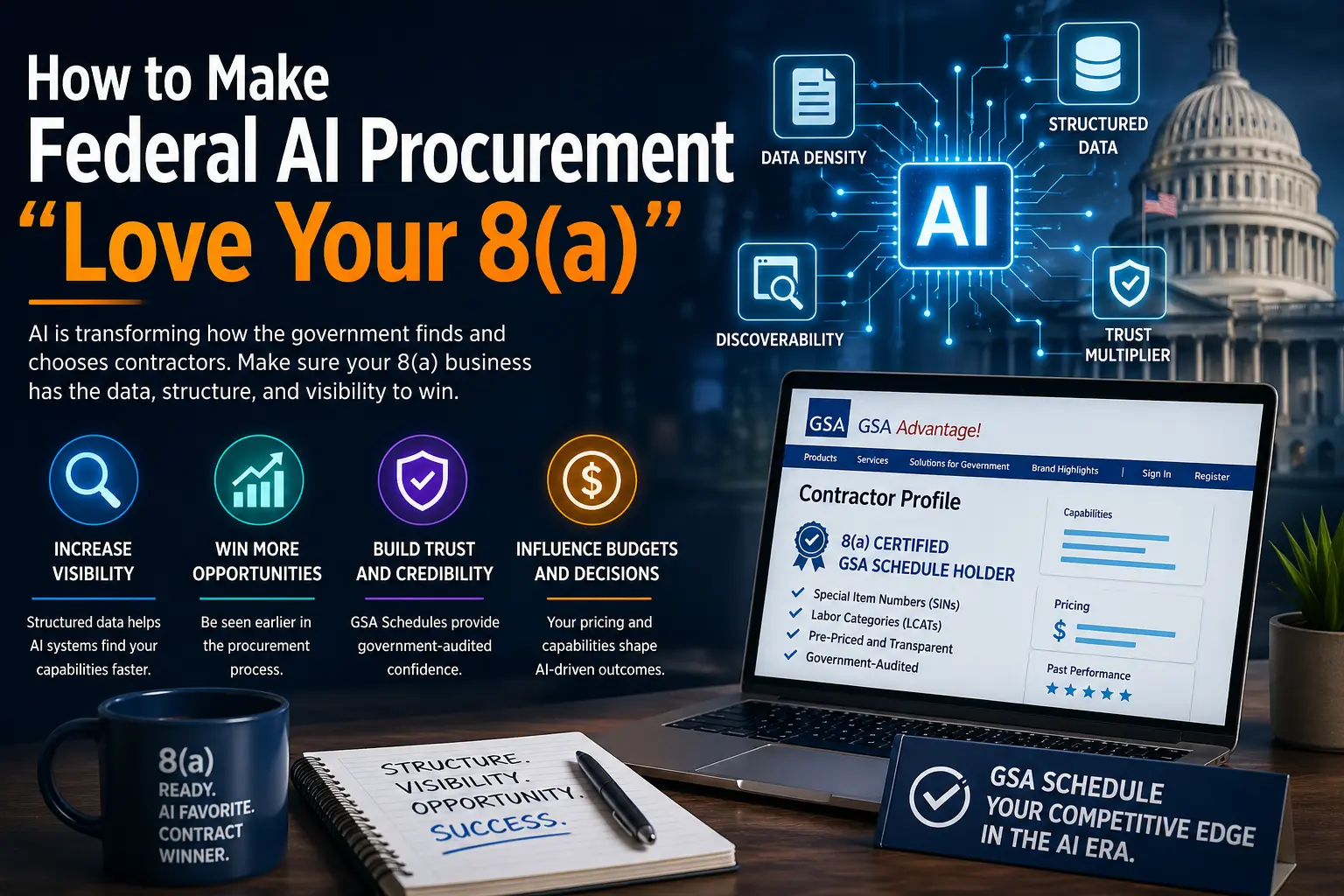
We conducted a study in 2024, the results were that an 8(a) firm with a GSA Schedule gets about $1MM per year in federal sales from the GSA Schedule. But on a deeper dive we looked at the synergistic overall marketing value and 8(a) firms with GSA Schedules had 2.5x the overall sales of 8(a) firms in the same industry without a schedule. This is likely because procurement officers for the most part do their market research on GSA Advantage and GSA library rather than on Sam.gov, so these firms are gaining opportunities non schedule holders are not getting.
The 8(a) AI Lover: How Artificial Intelligence Is Reshaping Federal AI Procurement
Fast forward to 2026 and the AI era for Government Procurement is upon us. An important thing to know about AI is that if it could love, I am not sure it can do that yet, but if it could it would love two things:
- Data Density;
- Structured Data.
What does this mean for current and future 8(a) contractors?
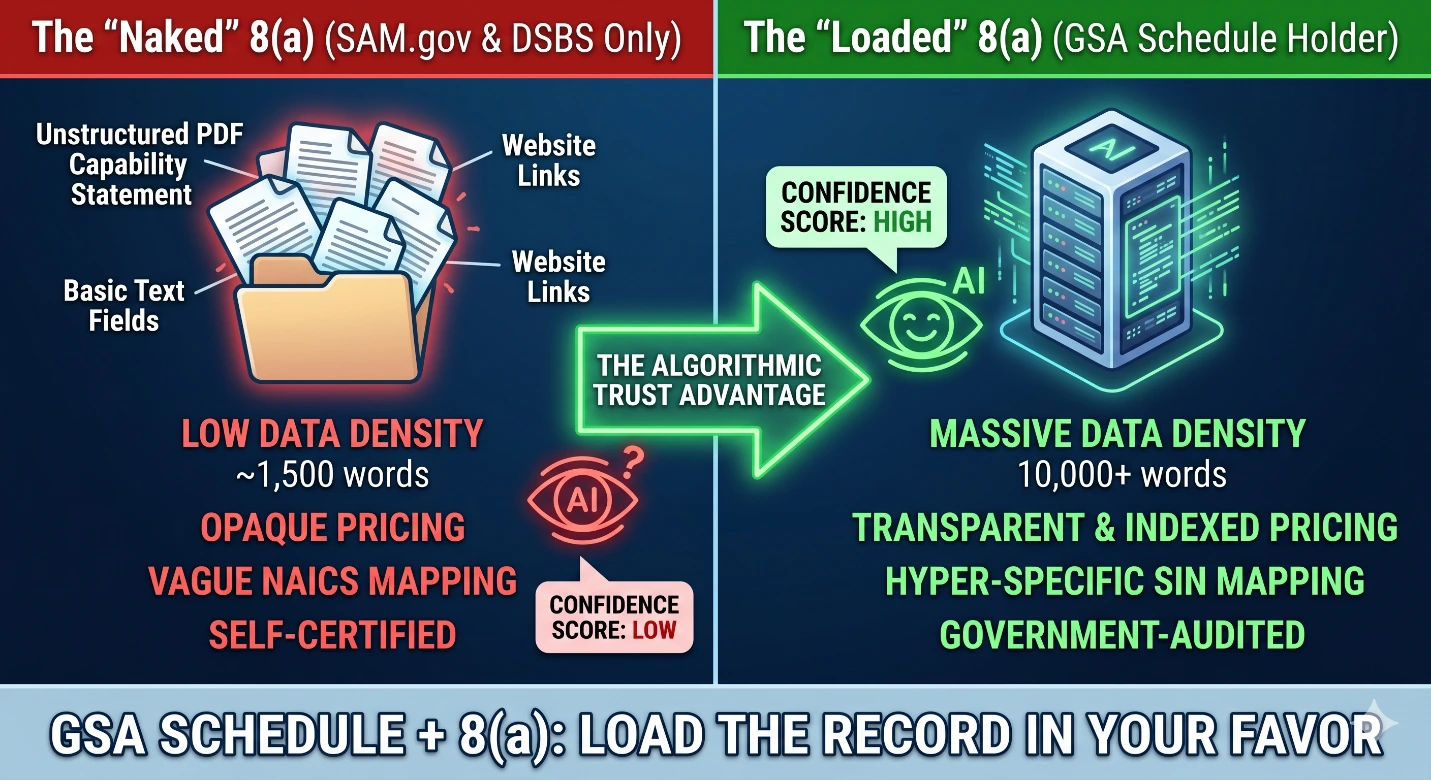
I have created the following table to illustrate how only a GSA Schedule gives you the ability to “load the record” so to speak so that AI can float your company to the top. (Note: It is true that AI would show this same love to an 8(a) firm positioned on large GWACs like OASIS+, Polaris, and 8(a) STARS III, which offer a similar algorithmic benefit).
| Data Dimension | The “Naked” 8(a) (SAM.gov & DSBS Only) | The “Loaded” 8(a) (GSA Schedule Holder) | Why the AI Cares |
| Data Format | Unstructured: PDF capability statements, basic text fields, website links. | Highly Structured: API-ready databases, standardized templates, JSON/XML catalog feeds. | AI struggles to parse unstructured PDFs. It prefers structured databases where it can instantly cross-reference columns and rows. |
| Keyword Density | Low: ~500 to 1,500 words total across a standard DSBS profile and 2-page PDF. | Massive: 10,000+ words across dozens of highly detailed Special Item Numbers (SINs) and Labor Category (LCAT) descriptions. | Vector search algorithms rely on semantic volume. More technical keywords equals a exponentially higher probability of being “discovered.” |
| Pricing Visibility | Opaque: Zero pricing data available until a human Contracting Officer asks for a quote. | Transparent & Indexed: Every hourly rate and unit price is publicly indexed and pre-calculated. | AI uses GSA pricing data to build the government’s budget (IGCE). If you are on Schedule, you are literally training the AI’s financial models. |
| Capability Mapping | Vague: Relying on broad, 6-digit NAICS codes (e.g., 541511) which cover thousands of different tech functions. | Hyper-Specific: Explicitly mapped to GSA Special Item Numbers (SINs) which dictate exactly what you are legally allowed to sell. | AI wants certainty. A NAICS code is a suggestion; a GSA SIN is a legally binding capability verification. |
| Audit Status | Self-Certified: You typed your own capabilities into SAM.gov. | Government-Audited: Your financials, past performance, and pricing were audited by a GSA Contracting Officer. | The AI applies a massive “Trust Multiplier” to data that has already survived a federal audit. |
The Growing Advantage: From 2.5x to 4x Growth Potential
If the advantage for an 8(a) firm + GSA Schedule was 2.5x over an 8(a) alone… I could see this advantage creeping into the 3x-4x range in the near future. If you want to make the most of your firms 9 years in the 8(a)-program obtaining a GSA Schedule so you have both the structure and density of data, you need to allow AI to make beneficial decisions for your company.
Are you ready to load the system in your favor? If you would like to find out if your firm qualifies for either a GSA Schedule or an 8(a) Certification, give us a call today. We are always happy to help!