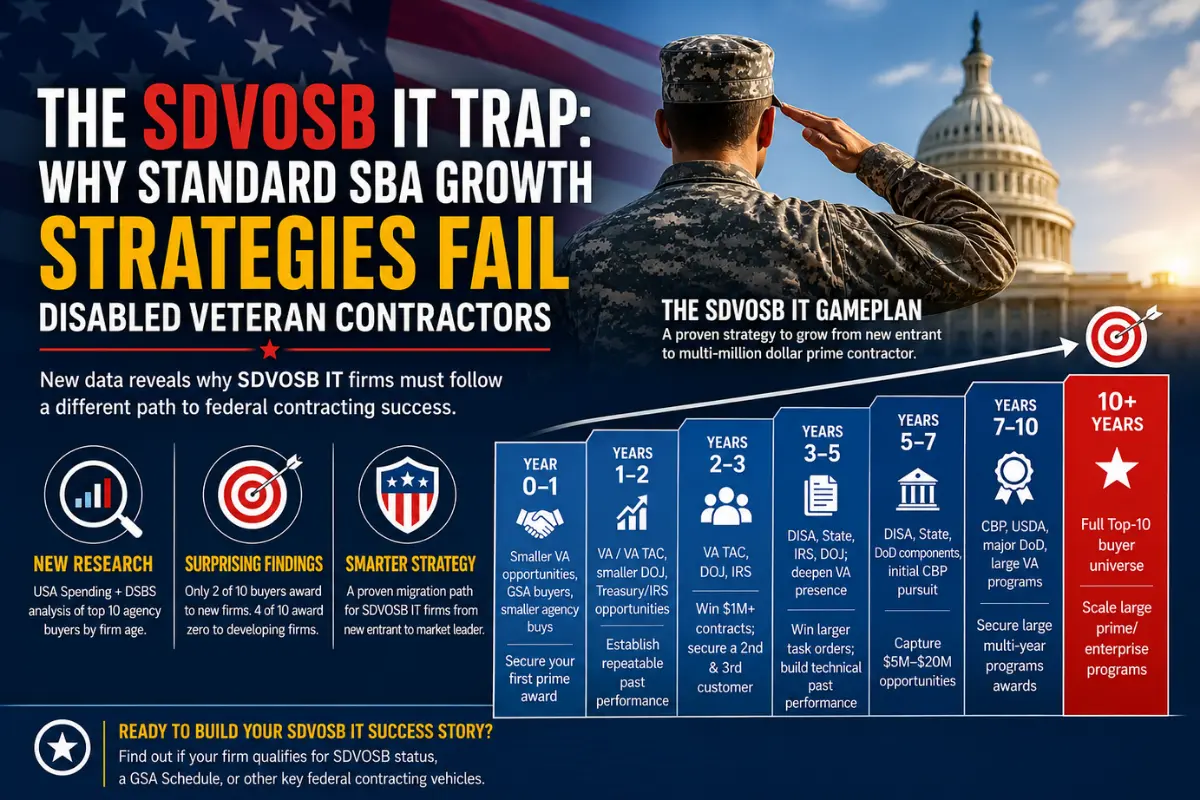
Our study combining USA Spending data with the Dynamic Small Business Search (DSBS) revealed a surprising finding, one that completely changes how Service-Disabled Veteran-Owned Small Business (SDVOSB) firms should pursue IT contracting compared to other SBA certification holders (8(a), WOSB, and HUBZone).
What the Data Reveals About SDVOSB IT Contracting
When analyzing the top 10 agency buyers for each set-aside program alongside firm certification age, 8(a), WOSB, and HUBZone businesses demonstrated a predictable progression from entry-level to established contracting. This is not true for SDVOSBs.
As shown in the data below, out of the top 10 agency buyers for SDVOSB IT, only the VA TAC and the IRS award contracts to firms with little-to-no past performance (0–2 years old). Furthermore, 4 out of the 10 buyers award zero contracts to firms in their “Developing Phase” (3–5 years).
For other certification holders, standard advice is to target the largest agency buyers immediately and grow over time. For SDVOSB IT firms, that strategy is a dead end.
Also read our article: The 8(a) supplier pool just collapsed by 40% – What it means for you
Top 10 SDVOSB IT Agency Buyers
| Buyer | Contracting-Office Location | New (0–2 yrs) | Developing (3–5 yrs) | Established (6–9 yrs) | Mature (10+ yrs) |
| VA TAC | Eatontown, NJ | 15% | 36% | 12% | 36% |
| State AQM | Washington, DC / Arlington, VA | 0% | 14% | 43% | 43% |
| DISA PL83 | Scott AFB, IL | 0% | 30% | 70% | 0% |
| CBP IT | Washington, DC | 0% | 0% | 33% | 67% |
| DLA Philadelphia | Philadelphia, PA | 0% | 0% | 0% | 100% |
| IRS IT Strategy | DC / Maryland | 8% | 15% | 62% | 15% |
| HHS OMAS IT | DC / Maryland | 0% | 0% | 100% | 0% |
| USDA OCP-POD | Fort Collins, CO | 0% | 20% | 30% | 50% |
| DOJ JMD | Washington, DC | 0% | 22% | 33% | 44% |
| FBI-JEH | Washington, DC | 0% | 0% | 0% | 100% |
How Should an SDVOSB IT Firm Break Into Federal Contracting?
To successfully enter and scale in the federal landscape, SDVOSB IT firms must follow a structured migration path, moving intentionally from a new entrant to a mature prime capable of capturing multi-million-dollar awards from top-tier buyers.
Also read our article: SDVOSB GSA Schedule Revenue Potential: 10-Year Study of 2,200+ Firms
SDVOSB IT Contracting Growth Strategy by Federal Maturity
| Federal Maturity | Primary Targets | What You’re Trying to Accomplish | GSA / Vehicle Strategy |
| Year 0–1 | Smaller VA opportunities, GSA buyers, smaller agency buys | Secure your first prime award | Get a GSA MAS immediately; use eBuy |
| Years 1–2 | VA / VA TAC, smaller DOJ, Treasury/IRS opportunities | Establish repeatable past performance | Leverage MAS + eBuy; pursue agency BPAs |
| Years 2–3 | VA TAC, DOJ, IRS | Win $1M+ contracts; secure a 2nd & 3rd customer | Add OASIS+ SDVOSB / relevant IDIQs |
| Years 3–5 | DISA, State, IRS, DOJ; deepen VA presence | Win larger task orders; build technical past performance | Major GWAC/IDIQ access becomes critical |
| Years 5–7 | DISA, State, DoD components, initial CBP pursuit | Capture $5M–$20M opportunities | Team on vehicles you don’t hold; prime where you do |
| Years 7–10 | CBP, USDA, major DoD, large VA programs | Secure large multi-year program awards | Maintain multiple GWACs/IDIQs + agency BPAs |
| 10+ Years | Full Top-10 buyer universe | Scale large prime/enterprise programs | Portfolio of vehicles; mentor younger firms |
Summary & Next Steps
Gaining access to GSA eBuy requires holding a GSA Multiple Award Schedule (MAS). While your firm may eventually outgrow a standard schedule and transition to larger GWACs (like OASIS+) or agency-specific BPAs, starting with a GSA Schedule creates the path of least resistance for new SDVOSB IT firms.
To learn more about this strategy, or to find out if your firm currently qualifies for SDVOSB status, a GSA Schedule, or other key federal contracting vehicles, call us today at 859-442-3300.