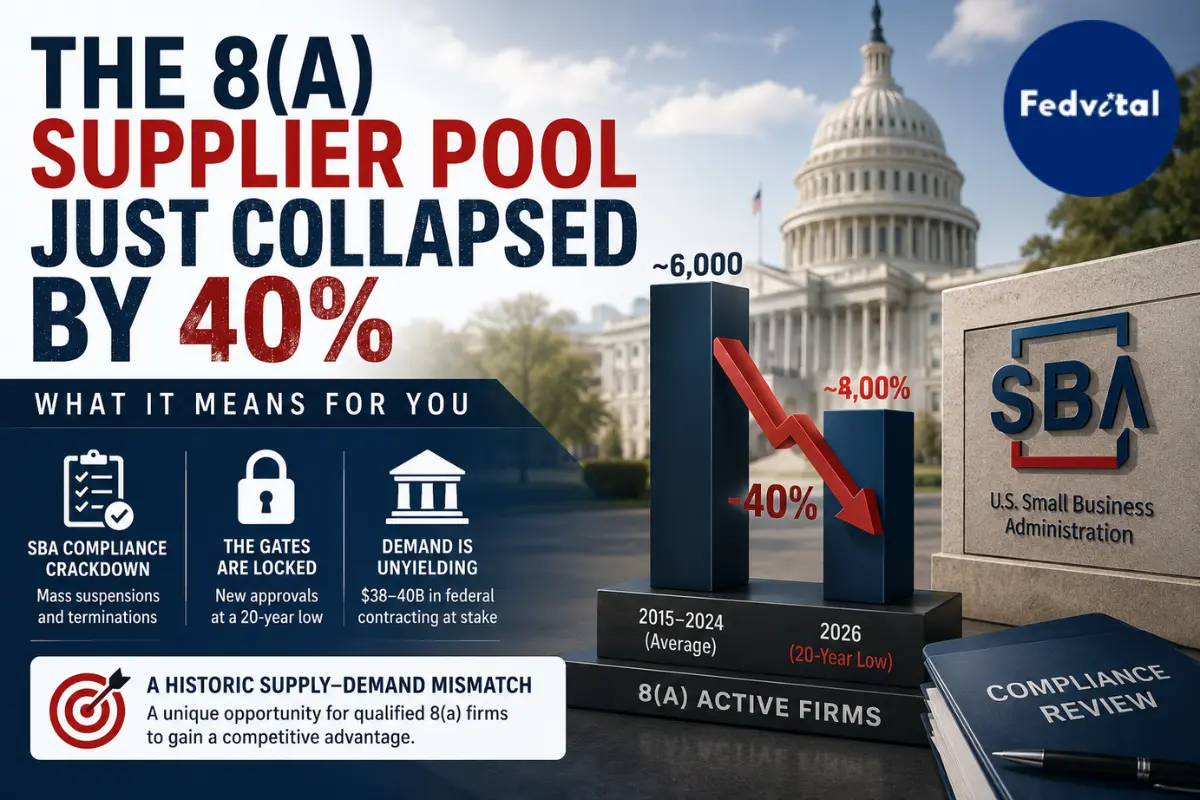
For almost a decade the number of 8(a) firms sat between 5,500 and 6,000 firms. Then came the removal of 8(a) firms due to the 2025 compliance check and a year of virtually no replacement. The results are the number of 8(a) firms now sits at 4,000, a 20-year low water mark.
As a result, the federal contracting market is sitting at an unprecedented vendor-supply-and-demand mismatch within the SBA 8(a) Business Development Program. While the mainstream business community assumes the program is to now challenge to qualify for or too risky to maintain the certification, a massive competition reduction has occurred. Which to the benefit of new 8(a) firms have cleared out many of the most successful 8(a) firms that were serving as “pass through” for larger federal contractors.
Detailed Breakdown of Events in the 8(a) Program Collapse
In December 2025, the SBA issued a sweeping, mandatory data call to all active 8(a) participants. Firms were given a tight deadline to hand over three full years of granular financial records, payroll registers, bank statements, and subcontracting agreements to weed out shell companies and “pass-through” schemes.
The fallout was immediate and severe:
- Mass Suspensions: In late January 2026, the SBA instantly suspended over 1,000 contractors who failed to submit the required documentation.
- Economic Disadvantage Trimming: In February 2026, the SBA suspended or moved to terminate another 150+ high-profile firms for failing to meet strict net-worth compliance rules.
- Mass Terminations: In March 2026, the agency launched formal termination proceedings against 620 additional firms that refused to open their books.
In less than a single quarter, the active pool of 8(a) suppliers collapsed by nearly 40%.
Why the Pipeline Froze: The Bottleneck in New 8(a) Admissions
While existing firms were being kicked out by the hundreds, the pipeline to replace them completely froze.
This was because the SBA was overhauling to an individualized, race-neutral evaluation standard. The agency accepted just 65 new firms into the entire 8(a) program in 2025, not even a blip in terms of normalcy which is 500-750 firms admitted in a normal year.
With the historical backlog cleared out and new approvals slowed to a crawl, the competitive field has never been thinner.
Also read our article: GSA eBuy for 8(a) Businesses: The Ultimate “Cheat Code” for Federal Contracting Success
Persistent Demand: Why Contracting Officers Are Desperate for 8(a) Firms
8(a) contracting goals are currently at a 5% minimum; federal agencies are facing severe structural pressure. This $38-40B in federal sales is large underserved market due to lack of 8(a) firms.
Every federal agency is legally required to meet this 5% minimum and for most agencies this means routing billions of dollars to firms via 8(a) set-asides and sole-source mechanisms.
Because the SBA forcefully removed over a third of the eligible contractors, procurement officers are left with billions of dollars in quotas, but a fraction of the suppliers needed to fulfill them.
The Contrarian Play: How to Capitalize on the 8(a) Program Collapse 2026
Entering the 8(a) market right now provides a distinct advantage precisely because the mainstream consensus says, “it’s too hard.”
The changes made in 2026 SBA were not designed to kill the 8(a) program but instead designed to strength it so that future legitimate 8(a) program participants could obtain the full benefits of the program.
Do you have 10 minutes this week for a brief qualification call to see if your firm meets the new SBA compliance standards?